
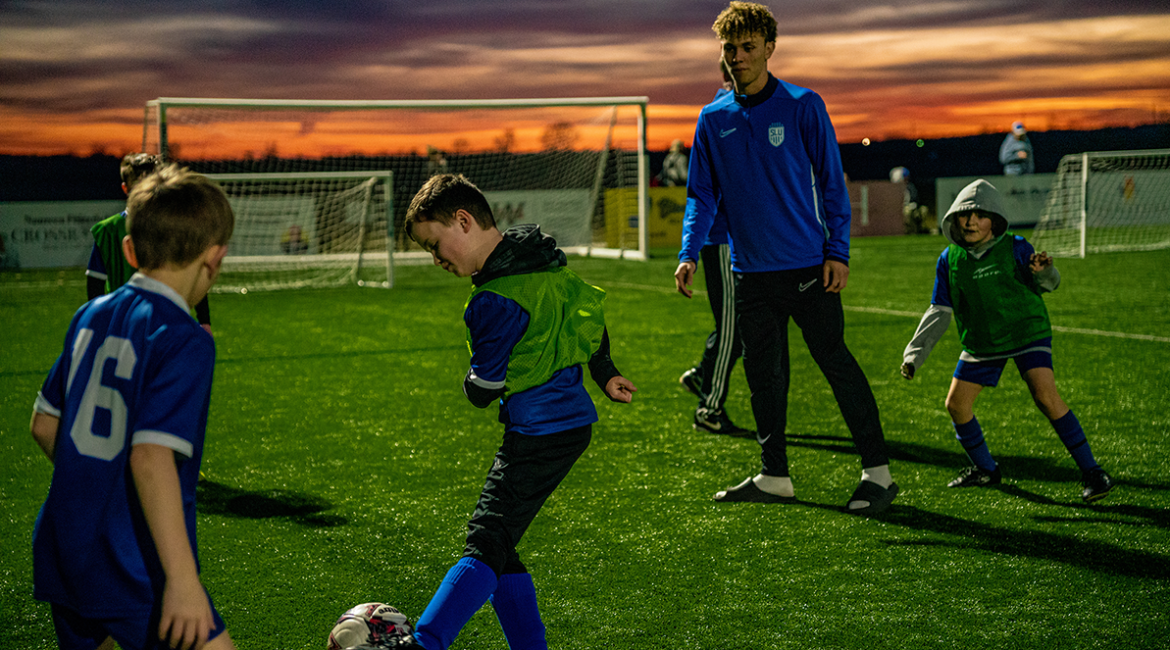
For families in Columbia, choosing when to introduce a child to soccer can feel like a bigger decision than it needs to be. Between school schedules, changing Southern Illinois weather, and other activities, parents often want to know whether their child is actually ready before signing up.
Most kids can begin exploring soccer around ages 3 to 5, but there is no single perfect starting age. At younger ages, the goal should be getting comfortable with a ball, following simple directions, moving with a group, and having fun. Older beginners can start successfully too. Readiness and enjoyment matter more than getting an early start.
What Columbia parents should know
-
Children around ages 3 to 5 can often participate in simple, play-based soccer activities without needing formal competition.
-
A child who enjoys running, kicking a ball, and playing alongside other kids may be ready even without previous soccer experience.
-
Southern Illinois heat, rain, cold snaps, and changing field conditions can affect how comfortable younger children are during practices.
-
Families in Columbia and nearby Monroe County communities should consider the practice schedule and travel commitment along with their child’s age.
-
Starting later does not automatically put a child behind, especially when the focus is learning fundamentals and enjoying the game.
What Is the Best Age for Kids to Start Soccer?
The best age for kids to start soccer is often between 3 and 5 for introductory activities, while more structured instruction may make sense as children get older. The right time depends on whether a child can enjoy group activities, follow basic directions, and stay engaged without feeling pressured.
For a preschooler, “soccer” may look more like running games, kicking a ball toward a target, and learning not to pick the ball up. That is completely appropriate.
As children move into elementary school, they can typically handle more structure. They may be ready to work on passing, dribbling, positioning, teamwork, and simple game concepts.
Columbia parents do not need to view a child’s first soccer experience as the beginning of a competitive sports career. A positive introduction can simply help a child discover whether soccer is something they enjoy.
Why Does Starting Age Matter for Columbia, IL Families?
Starting age matters because the right soccer environment should match a child’s physical, social, and attention development rather than simply the number on a birth certificate. For Columbia families, finding that fit can make practices more enjoyable and help children develop confidence around teammates, coaches, and the ball.
Young children are still learning skills that adults may take for granted. Waiting their turn, listening while excited, understanding boundaries, and recovering after making a mistake are all part of participating in a sport.
Local schedules matter too. Families may be balancing school, activities, and trips around Monroe County or into the greater St. Louis area. A soccer program that creates constant stress for the family may not be the best introduction, even if a child technically meets the age requirement.
Steamer’s Crew understands that parents are often looking for an activity their child can enjoy while learning and growing. We believe the starting point should make sense for the individual child and family.
How Can You Tell If Your Child Is Ready for Soccer?
A child may be ready for soccer when they show interest in kicking a ball, can participate in short group activities, and are willing to listen to basic instructions. They do not need polished coordination, advanced skills, or a detailed understanding of soccer before they begin.
Signs your child may be ready include:
-
They enjoy running and active play.
-
They regularly kick or chase balls for fun.
-
They can follow one- or two-step directions.
-
They can participate in a group without needing constant one-on-one attention.
-
They show curiosity about soccer or other team sports.
-
They can separate from a parent or caregiver for an age-appropriate activity.
-
They can handle small frustrations and return to playing afterward.
Not every box needs to be checked. A four-year-old who spends half a first session observing other children may simply need time to become comfortable.
Is Age 3 Too Young to Start Soccer?
Age 3 is not necessarily too young for soccer if the activity is designed around preschool development and emphasizes movement, play, and basic ball familiarity. At this age, parents should expect short attention spans and simple activities rather than organized matches with complicated rules.
For a three-year-old, success might mean kicking the ball several times, staying involved for part of an activity, and leaving excited to come back.
That is very different from expecting a child to understand positions or maintain formation.
Columbia parents should look at what a program actually asks children to do rather than judging it only by the word “soccer.” An age-appropriate introduction should feel accessible to young beginners.
Is Age 4 or 5 a Good Time to Begin Soccer?
Ages 4 and 5 can be a good time to begin soccer because many children are becoming more comfortable with group instructions, active games, and basic coordination. They can still learn through play while gradually developing more purposeful skills such as dribbling, passing, stopping the ball, and shooting.
Children develop at different speeds, so two Columbia kindergarten-age children can have very different experiences.
One may immediately want to chase the ball everywhere. Another may be cautious during the first few sessions. Neither reaction automatically indicates future ability.
The more useful question is whether the child is engaged enough to keep learning.
Is Age 6, 7, or 8 Too Late to Start Soccer?
Ages 6, 7, and 8 are not too late to start soccer, and children beginning during elementary school can still learn the fundamentals successfully. Older beginners may actually pick up certain concepts more quickly because they can listen longer, understand demonstrations, and connect instructions with what happens during play.
Parents sometimes worry when other children have already played for several seasons. That experience difference can be noticeable initially, particularly with dribbling and ball control.
It does not mean a beginner cannot participate.
For families in Columbia, Waterloo, Millstadt, and other nearby communities, the better priority is finding an environment where beginners can develop fundamentals without feeling embarrassed about what they have not learned yet.
What Should Young Beginners Learn First?
Young soccer beginners should first learn comfort with the ball, basic dribbling, stopping the ball, simple passing, shooting, movement, and listening during activities. Tactical concepts can come later after children build enough control and confidence to participate comfortably.
Early development might include:
-
Moving with the ball close to the feet.
-
Stopping and changing direction.
-
Kicking toward a target.
-
Passing over short distances.
-
Recognizing basic field boundaries.
-
Playing cooperatively with other children.
For younger Columbia players, repetition does not have to mean standing in lines and performing the same drill repeatedly. Games and challenges can give children repeated touches while keeping them interested.
How Does Southern Illinois Weather Affect Youth Soccer?
Southern Illinois weather can affect youth soccer by changing field conditions, hydration needs, clothing choices, and how long young children remain comfortable outdoors. Columbia experiences hot and humid periods along with cooler conditions, rain, and seasonal temperature changes, so parents should prepare for conditions rather than assuming every session will feel the same.
Young players may be especially sensitive to uncomfortable weather.
Parents can check conditions before leaving home, bring appropriate clothing and water, and follow the program’s instructions regarding weather-related changes. After rainfall, natural grass surfaces can also feel considerably different under a young player’s feet.
Seasonal flexibility is simply part of participating in outdoor activities in Monroe County.
What Mistakes Should Parents Avoid When Starting Youth Soccer?
Parents should avoid treating early soccer participation as a race to develop advanced skills. Comparing children, emphasizing results too early, overscheduling, and expecting young players to maintain adult-level focus can turn an activity that should build enthusiasm into something stressful.
Mistake: Comparing a beginner with experienced players.
Consequence: The child may focus on what they cannot do instead of what they are learning.
Better approach: Measure progress against the child’s own starting point.
Mistake: Coaching constantly from the sideline.
Consequence: Multiple instructions can become confusing during play.
Better approach: Let the child listen to the person leading the activity.
Mistake: Focusing heavily on goals and wins.
Consequence: Children may associate success only with the scoreboard.
Better approach: Notice effort, learning, teamwork, and willingness to try.
Mistake: Choosing a schedule the family cannot comfortably maintain.
Consequence: Practices can become another source of household stress.
Better approach: Consider school, travel, other activities, and family time before committing.
What If Your Child Has Never Played Soccer Before?
A child who has never played soccer before can still start by learning the same foundational skills every player once had to learn. Beginners do not need previous team experience to begin developing dribbling, passing, shooting, coordination, and an understanding of how soccer activities work.
A common local scenario is a Columbia elementary-age child becoming interested because classmates or friends play.
The parent may worry that everyone else already knows what to do. During the first few experiences, the beginner may need extra time to understand drills or control the ball.
That is normal beginner territory, not evidence that the child started too late.
Should Parents Choose Casual Play or Structured Soccer Instruction?
Casual play is useful for exploration, while structured soccer instruction can provide organized opportunities to learn skills and receive feedback. Columbia families do not necessarily need to choose one or the other because backyard practice, recreational play, and organized instruction can complement each other.
| Option | Best For | Main Benefit |
|---|---|---|
| Casual ball play | Very young or uncertain beginners | Low-pressure exploration |
| Parent-child practice | Kids who want extra touches | Convenient repetition |
| Structured instruction | Children ready to learn specific skills | Guidance and organized development |
| Team play | Children ready for group competition | Teamwork and game experience |
A child who loves kicking a ball around at home may be ready for more structure. A child unsure about soccer may benefit from low-pressure exposure before a larger commitment.
How Can Parents Help Kids Improve Without Adding Pressure?
Parents can help young players improve by providing opportunities to touch the ball, encouraging effort, and allowing coaches or instructors to handle technical teaching. Even ten minutes of relaxed ball play can help a child become more comfortable without making soccer feel like homework.
At home, children can dribble around cones or safe household markers, pass with a parent, practice stopping a rolling ball, or shoot toward a simple target.
Keep the mood light.
For Columbia families with busy school-week schedules, short and enjoyable practice opportunities may be easier to sustain than lengthy training sessions.
What Can Parents Expect as Their Child Learns Soccer?
Parents can expect soccer development to be uneven, especially during the first months of learning. A child may suddenly improve at dribbling while continuing to struggle with passing, positioning, or confidence in games, and those differences are a normal part of acquiring several new skills simultaneously.
Parents should look for gradual signs of progress, such as greater comfort touching the ball, improved willingness to participate, better listening, or increased understanding of basic game situations.
The goal is development over time, not immediate mastery.
Ready to Explore Soccer Options?
If your child is interested in soccer, we can help you explore an age-appropriate way to get started.
What Areas Can Families Consider for Youth Soccer Activities?
Families in Columbia can consider soccer opportunities both locally and throughout surrounding Monroe County communities, depending on the type of instruction and schedule they need. Nearby Waterloo and Millstadt are part of the broader local area, while some families also travel toward Belleville or the greater St. Louis region for youth activities.
Travel should still make sense for your household. For a young beginner, consistency and a positive experience can matter more than routinely making a long drive for a particular program.
What Is the Cost of Waiting to Introduce a Child to Soccer?
Waiting does not automatically create a disadvantage, but repeatedly postponing an activity a child genuinely wants to try can mean missing opportunities to explore an interest and develop basic skills. Parents should balance that consideration against readiness, family schedules, and whether an available program provides an appropriate environment.
There is no need to enroll a preschooler simply because other families have.
Likewise, parents should not assume an eight-year-old has missed the window because classmates started earlier.
If your child keeps asking about soccer, that interest itself may be a good reason to explore the next step.
Help Your Child Take the Next Step
If your child is ready to try soccer, contact us to learn more about available options and determine what may fit your family.
Frequently Asked Questions About Kids Starting Soccer in Columbia, IL
What age can kids start soccer in Columbia, IL?
Kids can often begin introductory soccer activities around ages 3 to 5, provided the program is designed for young children. At that stage, activities should emphasize movement, simple ball skills, listening, and enjoyment rather than complicated tactics or competitive results. Parents should also consider their individual child’s readiness.
Is 3 years old too young for soccer in Columbia?
Three years old is not automatically too young for soccer in Columbia if the activity is specifically designed for preschool-age children. Parents should expect simple games, basic kicking, movement, and short periods of instruction. A three-year-old does not need to understand positions or formal match strategy to benefit from an introduction.
Can my 5-year-old start soccer without experience?
Yes, a five-year-old can start soccer without previous experience. Beginners can learn foundational skills such as dribbling, stopping the ball, passing, shooting, and following simple directions. For Columbia families, the priority should be choosing an environment where a new player can learn without being expected to perform like an experienced child.
Is 8 too late to start soccer in Monroe County?
No, age 8 is not too late to start soccer in Monroe County. An eight-year-old beginner may initially notice skill differences compared with children who started earlier, but older beginners can often understand instructions and concepts more readily. Consistent practice and an encouraging learning environment are more useful than worrying about the starting date.
What does my child need before starting soccer in Columbia?
Your child primarily needs interest, appropriate clothing and equipment required by the specific program, and a willingness to participate. Exact equipment requirements can vary, so Columbia parents should check with the program before purchasing gear. Younger children do not need advanced soccer skills or previous organized sports experience before their first session.
How should kids practice soccer at home?
Kids can practice soccer at home through short, playful activities such as dribbling around safe markers, passing with a parent, stopping a rolling ball, and shooting toward a target. Families in Columbia should choose a safe surface with adequate space and supervision. Short sessions can provide useful repetition without making practice feel like an obligation.
Can kids play soccer during hot Southern Illinois weather?
Kids can participate in soccer during warmer Southern Illinois conditions when activities are managed appropriately, but parents should pay attention to weather, hydration, and program guidance. Heat and humidity can make outdoor activity more demanding, particularly for young children. Families should follow weather-related instructions and avoid pushing a child who appears unwell.
Should my child play soccer year-round?
Children do not necessarily need to play soccer year-round to learn and improve. Columbia families can choose a schedule that fits the child’s interests, age, school commitments, other activities, and family routine. Breaks and participation in different activities can also be part of a balanced childhood rather than evidence of falling behind.
Give Your Young Player a Positive Start in Columbia
The best age to start soccer is the age when your child is interested and ready for an appropriate level of instruction. Whether that happens at 3, 5, 8, or later, a positive first experience can help build skills, confidence, and enthusiasm for being active.
Help Your Child Start Soccer With Confidence
We can help Columbia-area families explore a soccer experience focused on learning, participation, and age-appropriate development.